The 10 big lies about America by 9780307449832
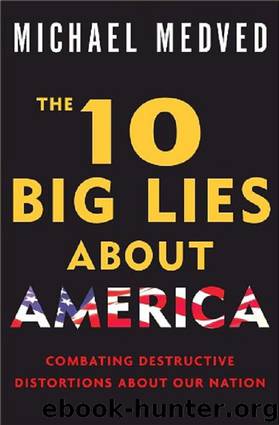
Author:9780307449832
Language: eng
Format: epub
Published: 2017-08-18T04:00:00+00:00
DELAYED RECOVERY, PROLONGED DEPRESSION
In 1931, in some of the darkest days of the Great Depression and the middle of the Hoover administration, the national unemployment rate stood at 17.4 percent. Seven years later, after more than five years of FDR and literally hundreds of wildly ambitious new government programs, after more than a doubling of federal spending, the national unemployment rate stood at—17.4 percent! As economist Jim Powell points out in his devastating book FDR’s Folly, “From 1934 to 1940, the median annual unemployment rate was 17.2 percent. At no point during the 1930s did unemployment go below 14 percent. Even in 1941, amidst the military buildup for World War II, 9.9 percent of American workers were unemployed. Living standards remained depressed until after the war.”
In his celebrated First Inaugural Address of March 4, 1933, FDR unequivocally declared: “Our greatest primary task is to put people to work. This is no unsolvable problem if we face it wisely and courageously.”
But for the president and his economic planners, the task of putting people to work did remain an unsolvable problem—until world conflict led to sixteen million Americans leaving the workforce for the military, and millions more finding new jobs in humming defense plants. Considering Roosevelt’s self-proclaimed priorities, the persistence of devastating unemployment (in an era when the typical family relied on only one wage earner and women for the most part stayed away from the workforce) should alone identify the New Deal as a wretched, ill-conceived failure.
Other measures of recovery show similarly dismal results. After the stock market crash and the beginning of the Great Depression, the Dow Jones Industrial Average hit 250 in 1930 under Hoover (it had been 343 just before the crash). By January 1940, after seven years of New Deal “experimentation,” the market had collapsed to 151; it remained in the low 100s through most of Roosevelt’s terms and didn’t return to its 1929 levels until the 1950s. At the same time, federal spending as a percentage of the gross domestic product soared at an unprecedented rate: from 2.5 percent in 1929 to 9 percent in 1936 (long before the wartime spending began). In other words, the portion of the total economy controlled by Washington increased by a staggering 360 percent in the course of just seven years—without providing discernable benefit to the economy.
Such statistics look so disturbing, so incontrovertible, that they raise serious questions about the survival of the myth that the New Deal fixed the Depression.
How could reputable historians pretend that the vast expansion of government power between 1933 and 1941 somehow brought the nation out of its persistent, nightmarish economic misery?
Out of curiosity, I took from my shelf the college history textbook assigned to me at Yale in 1968. The relevant chapters had been written by Arthur Schlesinger Jr., the most acclaimed and authoritative of all New Deal historians. To my surprise, not even this fervent liberal, a onetime Kennedy aide and stalwart admirer of FDR, pretended that his hero’s policies had solved the Depression.
Download
This site does not store any files on its server. We only index and link to content provided by other sites. Please contact the content providers to delete copyright contents if any and email us, we'll remove relevant links or contents immediately.
| Anthropology | Archaeology |
| Philosophy | Politics & Government |
| Social Sciences | Sociology |
| Women's Studies |
The Secret History by Donna Tartt(19306)
The Social Justice Warrior Handbook by Lisa De Pasquale(12224)
Thirteen Reasons Why by Jay Asher(8999)
This Is How You Lose Her by Junot Diaz(6960)
Weapons of Math Destruction by Cathy O'Neil(6370)
Zero to One by Peter Thiel(5870)
Beartown by Fredrik Backman(5840)
The Myth of the Strong Leader by Archie Brown(5552)
The Fire Next Time by James Baldwin(5506)
How Democracies Die by Steven Levitsky & Daniel Ziblatt(5274)
Promise Me, Dad by Joe Biden(5191)
Stone's Rules by Roger Stone(5131)
A Higher Loyalty: Truth, Lies, and Leadership by James Comey(5018)
100 Deadly Skills by Clint Emerson(4974)
Rise and Kill First by Ronen Bergman(4840)
Secrecy World by Jake Bernstein(4800)
The David Icke Guide to the Global Conspiracy (and how to end it) by David Icke(4773)
The Doomsday Machine by Daniel Ellsberg(4556)
The Farm by Tom Rob Smith(4550)
